Pages

Wednesday, November 20, 2013

Train touring in Ecuador ...

During our stay in Ingapirca we followed our wanderlust and took a side-bus trip into Tambo. As we entered the town we saw a train station with an odd looking train parked in front. Ah ha, a tourist train so off we tumbled in our haste to not miss anything. We had read about and heard about the various tourist trains and in fact wanted to take the one from the coast to Quito but had read that it wasn't running until Dec 8.
This train reminded us of the Goose that we rode in northern New Mexico years ago: A truck motor and transmission put onto a train chassis and a modified body built around it.


 yup, a typical tourist train. The fare was very good ... for a mere $36 we could ride the ride, regardless of the number of available passengers for the trip. When do we leave? Whenever you want. Yes!
 Our route would take us up to the Incan Baths at Coyoctor, you can see the water aqueducts and stone work found in the baths themselves. Apparently the baths are a religious rite and were used by only a select few.) 
and back, down into and through the valley. 
At the terminus, they had a round table that allowed for the turning of the train - all by manual labor. 

The next day, after reading the guide book, our jaunt took us to Alausí, and our next train ride. Alausí is  a quaint little (well, maybe not so little in the general scheme of things) town going north towards Quito, our final destination. OMG, the bus dropped us off on the highway, above, yes ABOVE the town. I asked if there were taxis available and was told yes. What I wasn't told was that the taxis were in the town proper. Crossing the road, we found a walkway, going down, down, down ...

 Although the town is nestled in a what appears to be a valley of the Andean highlands, it is actually on a plateau above the valley floor. 
A large religious statue of San Pedro towers from the edge of the plateau, over the town.

 The town is a colorful, quaint little town   everywhere people used the curbs as benches.
whose main call to fame is the La Nariz del Diablo train ride, our reason for coming and stopping in.   The local population were also very colourful with what appeared to be a love of the bright and vivid. One particularly interesting statue found near the market area depicted the shoeshine boys playing "bullfighter" in the street.

This train ride goes up and up, round mountains and through high altitude valleys. 

 You felt like you are going to the top of the world. It has the steepest ascent/descent of any railroad in the world (over 1000 meters), including 2 unique switchbacks which take you up the Devil's Nose.  Here you go headfirst up the side of the mountain, then stop, switch the tracks, and back down into the station. 


Once in the station, you then walk back up the mountain to get to the informational museum. 

As we stood looking down from the mirador, we happened to look up and actually saw a condor soaring between the mountains. Too far off to get a photo, but saw it we did.


The whole trip took only 4 hours, leaving us enough time to wander the town a little afterwards and then get on the bus to our next point and train ride ... Riobamba ... all the while continuously heading north to our final destination.

Ingapirca ...

A short 2+ hour bus ride from Cuenca brought us to Ingapirca, Ecuador's largest Inca ruins archeological site, and adjacent town. Ingapirca or Inca Wall in Kichwa, is located in the Andes mountains at 10,200 feet. It is not visible from the road and upon arrival it just sort of pops out at you.

We had arranged a room for a couple of nights at the Ingapirca Hotel, which is touted as being right on the edge of the ruins.
 Our welcoming committee.
Our bus dropped us off at the ruins entrance and the sign said, "Ingapirca Hotel" to the right. Yup up that there road a ways.

 Yup, up hill all the way.
Yup, father than on the edge of the ruins. Yup, we definitely accepted the ride in the back of the truck, packed in with all the workers going home: Cost 1$ each and definitely far better than trudging up the hill, dragging the suitcases in the gravel.

The hotel is wonderful - an old hacienda turned into a hotel, sitting on the side of the mountain overlooking the valley.  Our room is just like you would expect: large, luxurious, snuggle-into bed, old wooden furniture, large fireplace with a stack of wood, and a wonderful old-time smell, from fires of bygone years. 

The wait staff in the restaurant speak a multitude of languages, but with us they speak Spanish. Here we meet a friendly couple from Switzerland who, in their other lives, lived and worked with an NGO in Peru.

Their conversation was definitely that of a development worker and we spend many lively hours talking with them, in Spanish, as he spoke a little English and she none at all, until it became evident that the staff were trying to shut down the restaurant.

Retiring to our room, it became real apparent that there was no heat. We were told that we couldn't use the fireplace as the smoke would bellow into the room rather than go up the chimney. What? How about opening the flue? Not. Our waiter handed us both hot water bottles filled with boiling hot water. No wonder the beds had multiple wool blankets and an eiderdown blanket. Snuggling into the hot water bottle was heavenly, I can tell you. 

The next day was reserved for wandering and experiencing this beautiful place. And what a magical place it was. The surrounding mountains were shrouded in clouds, promising a downpour later in the day, yet we were given sunshine as we left the hotel.  Now, not only were we foreigners and then extranjeros, but also Shuktak mamallaktakunamanias in Kichwa. Wow that is a mouthful.

We chose, as we always do, to do a tour. Our guide wanted to practice his English, something that he was rightly very proud of.  Always ready to give an elaborate explanation to any question, we can see the unique and easily identified Inca workmanship of the stonework behind us on which he expounded at great length.As we came into view of the ruins, we were rewarded with a golden view of sunshine, with mist hovering in the background. Wandering the grounds, viewing the various accomplishments and the celestial/archeoastronimcal significant pieces, we were awed at the workings.
 a lunar calendar

 every nook and cranny had some story or significance 

 Today, as in bygone eras, manual labour was and is the standard, although we did see the occasional tractor being used. 
 
From our views on top we saw the remnants of the old Inca Trail and approaching clouds.  Can you imagine running on these stones? This oddly enough led to a definite "touristy" attraction, The Inca Face.  which meant walking down the very same Inca Trail - very steep and slippery, which means we also had to come back up! Along the way a wizened old lady tried to entice us into buying some supposed "artifacts." Were they indeed artifacts, or was someone being ingenious in tourist sales? We didn't find out but we did buy a bottle of water from her. 

The touring here took all of a morning so in the afternoon we took our own bus tour down into the surrounding towns ....


Monday, November 18, 2013

A little here, a little there ... then back ...

Danny had a hankering to return to Vilcabamba. He found a really cool B&B/hostal on the side of the mountain just outside of town - just far enough that walking into town was not always an option. Again, as a followup to Danny's blog ...

This B&B/hostal, Montesueños, was the brain child of one of the US's first astronauts from the late 60's - the Mars' program. Never heard of it? I hadn't either but that is what his bio states. I even googled it: this is but one of the entries that turned up:  http://www.airspacemag.com/space-exploration/Road_to_Mars.html His name? Dr. Brian O'Leary. You can read more here: http://en.wikipedia.org/wiki/Brian_O'Learyhttp://en.wikipedia.org/wiki/Brian_O'Leary A very eclectic place, one that requests quiet and relaxation of it's guest. The B&B itself is reminiscent of Gaudi's various works in Barcelona.
His life-long partner, wife, is an artist of different mediums and has utilized what is found in nature as well as scavenging to decorate. In the photo upper left, the open door on the main floor is the door to our room. 
From the overlooking patio, we had a perfect view of Mondango, the sleeping Inca.
We were far enough up the mountainside that we had an awesome 270' view of the valley spreading out before us. Behind us was the mountain.
 

We limited ourselves to four more days here as we probably would have continued to stay and spend the rest of our time in one place.

Packing our bags, looking fondly backward, our taxi took us down for the last time. We caught a bus for our next adventure. 

As we rode the bus north towards Cuenca, our stopping point for the night, we passed through one of the more traditional towns. It was a place worth visiting but without hotels near the bus stop we felt that we would not take the chance of having to ride standing up all the way to Cuenca once we got off the bus. The bus was full and people were standing, a very usual occurrence. 
 the old and the new - these are school students "hanging around" after school.

 The men wear "highwater" pants and the women  long skirts, both wear the felted hats. The sandals are interesting as well, as they are of the same making as centuries past, only with newer fibers. The clothes are mostly black, with legend saying it is because they are in mourning from the Conquistidors' arrival and the loss of their identity and culture. Modern anthropologists poo-poo this however.

And so we arrived back in Cuenca, 
our stopping point for the night and with a last minute decision to stop for a couple more days. We wanted to see a museum that we missed while here before.

Another tour bus ride: 
 we are becoming quite the "selfless" with our new smartphones

hidden treasures yet to be seen:


And more roasted pig:

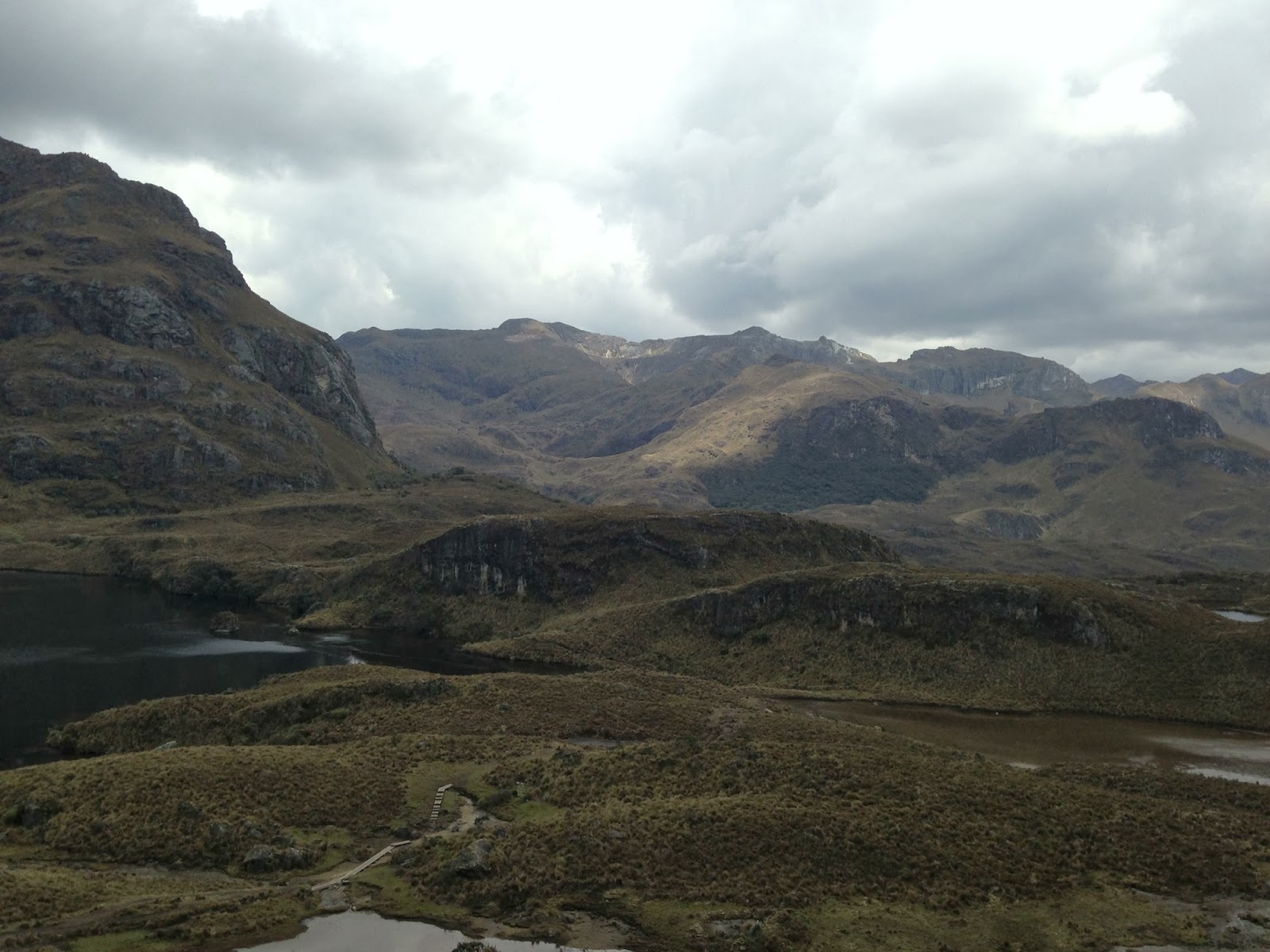
A car trip to Cajas National Park for Danny. He tried to go by bus but couldn't find one that went at the time that he wanted. As he wanted a day trip, not an overnight trip, he needed to be able to get back and therein was the problem. The PanAmerican highway goes right through Cajas and larger trucks and vehicles travel mainly at night through it. It appears that buses are somewhat limited as well, at least the ones that woulds top and pick someone up in the park. So taxi it was ... 
 a wild beautiful place renown for it's hiking


We made it to the museum


and then on to the hat museum and shop. Here we found our hats to take home with us. In fact, they mailed them home for us.


 sewing Danny's hat band on to his new hat


Finally came the time to once again hit the road. One of the things that we had wanted to see was the large archeological park just NNW of Cuenca. Reservations were made and off we went ...